Saturday, December 27, 2014
The Anatomy of a Peasant Economy
I found this while doing research on fiefs. I've been trying to decide upon a reasonable fief size. So I've been looking at feudal Japan and the fiefs - called han - during the Edo era and earlier. I stumbled upon this research paper: "Anatomy of a Peasant Economy - a Rice Village in the Philippines" while doing this research.
This paper dates from 1978 and looks at a typical rice village in Laguna province of the Philippines. There is a nice map of the village and very good statistical information on the number of families and, of course, crop yields, planting seasons and the like.
I think this could be a good example of what a typical village in the Mssúma delta might look like. The barrio is one of thirteen in the municipality of Pila. It is a relatively small village with only 95 households and a population of 549 (in 1974.) The households are divided between farmers (large and small) and landless workers. There are 54 of the former and 41 of the latter.
My thinking is that a similar Tsolyáni village - say one of those surrounding the village of Nisuél - might be of similar size, or perhaps slightly larger. Larger would be better, actually, as this takes up a really small patch of land and if all villages were this size then I have a lot more to draw! This village only covers a couple of hectares and the delta contains over 78,000 hectares! Some of that is lost to rivers, lakes and streams, marshes, secondary roads and footpaths, irrigation and transportation canals, the villages themselves, forested areas and orchards. It is still a lot of area...
Saturday, December 20, 2014
The Economic Aspects of the History of the Civilization of Japan, Volume 1
By Yosaburō Takekoshi
Why am I interested in a 1930's book with the esoteric title "The Economic Aspects of the History of the Civilization of Japan" you ask? And what has it got to do with Tékumel?
What indeed! :-) (Did I mention that there are at least 3 volumes in the series?) :-)
Fortunately, I think I am only interested in Volume One, which covers the earlier phases of Japan's rich history. I discovered this book while conducting deeper research into koku. See my previous post on the subject for my reasons. Google actually offers a pretty good preview of the text - except there are gaps in all the wrong places. Here are some sample pages:
...page 418 unfortunately not part of the preview. :-(
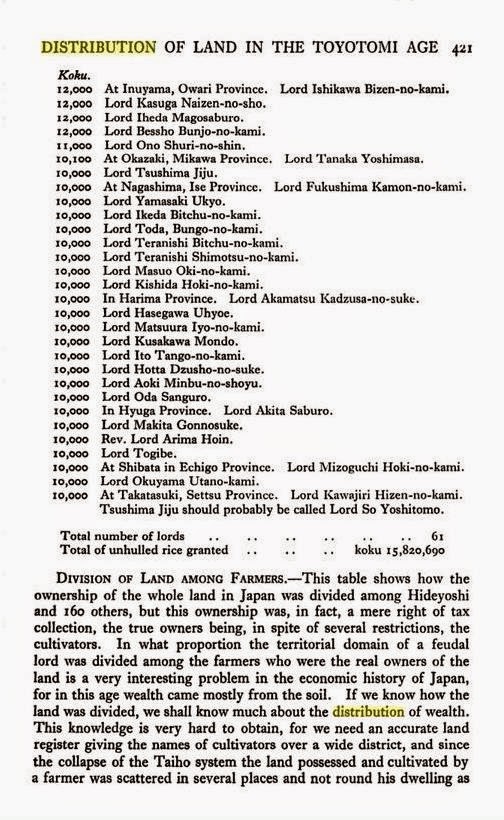
These pages show the koku associated with all the fiefs of feudal Japan in the Toyotomi Age. Unfortunately, page 418 is not included in the preview and that would be the page to detail the Shogun's holdings and those of the wealthiest lords. These preview pages are not without use, however, even with that gap.
For example, page 421 states that the total number of lords is 61. But it goes on to say that the land was divided between the Shogun (Hideyoshi) and 160 others. This I don't exactly understand. Pages 419 and 420 of the preview have 50 entries each and page 421 has I think 30 more. The missing page 418 could have another 50, giving a total of 180. Looking at the entries, some are shown by identifying the province and others are not, perhaps indicating that some lords have multiple fiefs under their control. I assume that is also the case with the Shogun, so while there are 61 lords (plus the Shogun?) there are 161 fiefdoms? Is that what it is saying?
There are other tantalizing details in the preview but in every case the missing pages get in the way of full understanding. :-(
I discovered that a copy of the original edition is available for about 700-800 GBP but I don't have that kind of cash. I have managed to order a copy of a later reprinted edition which as just over $25 plus postage. :-) That will not arrive until the New Year - February, actually if the delivery estimate is accurate. (Hopefully not!)
Friday, December 19, 2014
The Canals of Nisuél, Digitizing Tékumel, Part 16
The Mssúma Delta
The green-covered solo game book, "Adventures on Tékumel, Part 2, Volume 3: Beneath the Lands of Tsolyánu" provides the only published description of Nisuél and the surrounding region. The village of Nisuél is the headquarters of the Clan of the Golden Sunburst, a high status clan with a long and illustrious history. It is stated to be about 100 tsán north of Jakálla and in the Mssúma river delta. The delta is described as "lush and green" and "crisscrossed by canals and secondary roads". It is said to be the "produce-garden" that feeds the cities to the south.
Here I've started drawing in some canals. The book suggests that there are multiple fiefs in the area so that probably means more villages and more canals. To be honest I hadn't pictured it as this developed, but I could be thinking of the part of the delta further south and west. I think I'm going to limit the densely cultivated area to the area to the east of the Nyélmeyal river.
To give a sense of scale I've drawn two circles, both centered on Nisuél. The smaller has a 10 km radius and the larger a 50 km radius.
The Southern Coast
Next up is to sort out where my rivers (see list of names on the map and in my last post) are going to go. The intent is fill in the area between Penóm and Point Kuné with them. Maybe there could be one to the east of the Nyélmeyal river as well. We'll see...
Thursday, December 18, 2014
Fun With Names... Digitizing Tékumel, Part 15
I've been trying to come up with names for all the small rivers I've been adding to the map. I could of perhaps used the naming chart from the "Tsolyáni Without Tears" article that appeared in one of the early Dragon Magazines (to be found as a download on the Tekumel.com website.) Instead I went to the Tsolyáni Language books which are available as a PDF download at RPGNow.com.
I have to say that these books are fast becoming two of my favourite Tékumel books. Not because I think I have any hope of actually correctly pronouncing any of the words or that I want to learn the language. But because they are useful and contain quite a lot of insights - IMO - into Professor Barker's creation.
Anyhow, here are some of the names for rivers I have come up with. They all have more-or-less the meaning in the quotations. I say more-or-less because I am not a linguist and most of the language terms used in the books are new to me even when you are talking about English! So, if I've botched it: "oh well!" I think they look cool...
Gohóimu River "Festival"
Ubó River "Fever"
Ssünrü River "Fear"
Ssánga River "Mad/insane"
Prazhúrin River "Eternal"
Kárin River "Red"
Mikárun River "Black"
Jangáivu River "Emerald"
Zháurun River "Green"
Tathén River "Grey"
Baradá River "Wild"
Abásun River "White"
Kólumeljarài River "Exalted Emperor"
Kólumelbabàrkohàya River "Ever-glorious Empire"
Ogrún River "False"
Dhu’ónin River "Golden"
Ssudú River "Ghost"
Tabár River "Forbidden"
Sharé River "Gods Protect Us"
I reckon Nisuél, headquarters of the Clan of the Golden Sunburst is sitting on the banks of the Dhu’ónin river. The Gohóimu river will be nearby. The Ubó, the Tabár and the Sharé, and others with similar foreboding names will be used throughout the Flats, flowing south to the sea. The Ogrún is intended to be used for one of the off-shoots of the Mssúma river. (There is an off-shoot of the Mississippi, called the False river, which is part of the old watercourse which is now cut off and goes nowhere.)
I also tried coming up with some creature names. I use a lot of Proxy Figures. I don't mean just proxy models being used to represent Tékumeli creatures, but also other beasties I have imported into My Tékumel. Basically, if it is cool and exotic, I have little objection to including it if I have the need.
Take these Barzoomian Great White Apes, for example:
Great White Apes, by Bronze Age Miniatures
Of course, "ape" is not in the vocabulary so that caused a bit of difficulty. What I came up with was:
Qu’qúmabàsudàli "Great White Monster" (I think!) :-)
Monday, December 15, 2014
Koku...thinking about Fiefs
I have recently been reading a book about the 47 Ronin and that account reminded me of the feudal Japanese unit of measure – koku – which was used as a unit of wealth and represented “the amount of rice required to feed one man for one year”.
I’ve encountered this term before. The old Shogun boardgame used koku as a game element, as a points system to buy game pieces. Wouldn't it be nice, I thought, to have something similar to measure the relative wealth of temples, clans or individuals in a Tékumel game?
Myself, I prefer to avoid bookkeeping and keeping track of Káitars (the standard Tsolyáni gold coin) seems like it would get a bit tedious. And how do you figure out how much a clan brings in each year?
Greg Stafford’s Pendragon role-playing game uses an abstract system of represent fiefs and towns. Population is described using a POP stat, and there are Hydes and Hyrds stats to track crops and livestock respectively.
Lee Gold’s Lands of Adventure role-playing game used a Wealth stat. I’ve seen other games do similar things more recently but that was the first occurrence I can remember. Pelgrane’s The Dying Earth RPG, uses a Wherewithal stat which I think serves the same purpose.
In Japan the koku was a somewhat abstract concept. Fiefs that could not grow rice were still accessed a koku value (per wiki) and samurai were paid a stipend in koku. A clan's status was linked to the koku value of the fief or to the stipend paid.
In essence the koku value assigned to a fief was in many ways an indicator of the relative power of the fief. This is a useful concept that I think can be adapted for Tékumel. (Something that I don't think has been done yet...)
Saturday, December 13, 2014
The Incomparable Dejah Thoris Revealed!
In case you didn't know, I've been a big backer of Mike Burn's "Egyptian Miniatures" Indiegogo campaigns. Why? Because IMO the figures are - for the most part - perfect for Tekumel as well as Ancient Egypt. As Chirine will tell you, often times Phil would say what was needed was just "a guy in a kilt". :-) And from my point of view, buying the figures ready made is way better than making them myself! (You've probably heard that joke about how to make a million dollars in the miniatures business...)
Anyhow, Mike's latest campaign is in the home stretch as it were:
Hi Everyone!
Well it has come down to the last 48 hours of the campaign! It has been quite an exciting project with the release of a large number of cool new miniatures. We are getting closer to unlocking the next stretch goal which is the skeletal guards II set and I'm hopeful this wont be long. Yesterday, I received some new images of recently completed sculpts by David Soderquist which include the two female warriors with axes that are part of the unlocked stretch goal set, Egyptian Female Guards IV. There is also an image of the 2nd Tomb Robber set, which is the final stretch goal reward that is available for the campaign. I am going to post a few more images of these tomb robbing desperadoes in the gallery - they really are packed full of detail and character. To give a better chance of reaching the Tomb Robber set I am going to reduce the goal to $13000 to unlock them.
I have another surprise for you all - three amazing new Add-Ons! These are NOT stretch goal rewards, so there is no goal to be reached - Everyone can simply add them to their perk by making a contribution for the amount required and letting me know your selections. I was not sure these models would be sculpted in time before the end of the campaign, but pharaoh's overseer is persuasive and reach of his whip is long ;) The first Add-On was sculpted by Brother Vinni and is of a mummy kidnapping one of pharaoh's concubines, inspired by the Lon Chaney 1942 horror classic, The Mummy's Tomb. This awesome set also includes a standing version of the concubine and is available for only $15. The next new Add-On is the waterline crocodile sculpted by Andy Pieper - silently waiting in the Nile for a victim to snatch in its terrible jaws. This model is 25mm x 50mm (the same dimensions as a horse base) and is only $5. Finally, Dave Soderquist sculpted a lovely Egyptianised Dejah Thoris inspired model, called pharaoh's favourite. Adorned in lots of gold and jewels and little else, pharaoh's favourite holds a mirror and is yours for only $5! I thought it might be fun to end the campaign with a bang by surprising you all with these new Add-On models.
Thanks for your support and contributions - this range would not exist without them!
All the best,
Mike
From here: Indiegogo Campaign
The rest of Mike's figures are part of the Dark Fable range. Highly Recommended!
Subscribe to:
Posts (Atom)