Sunday, June 3, 2012

Arena Update...

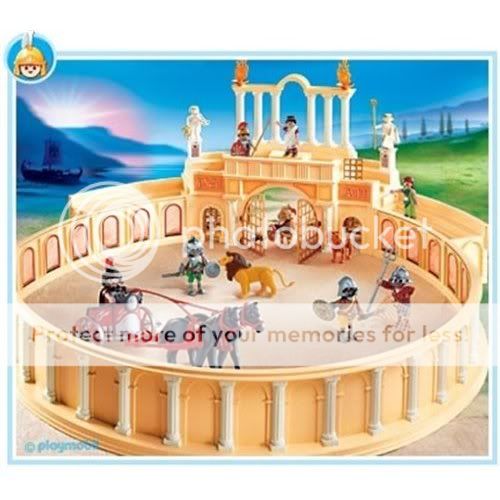
I didn't spot this at first, but one of the later posts to the arena thread on the Lead Adventure Forum mentioned that Playmobil had re-released their large Arena playset. And so they have! You can find it here...

Not sure if they ship to Canada or not. Often these big US companies do not. :-(

Thursday, May 31, 2012

A Hirilákte Arena For Your Very Own?

Read this thread, to find out how to transform this...


into this...


Simply Superb! :-)

Be careful though, if hunting on eBay, it seems to have been re-released as a smaller, partial set...

Friday, May 25, 2012

Warrior-Priestess of Karakán?


This new figure released by Dark Sword Miniatures is sculpted by Patrick Keith.

I think that with very few modifications she would make a very nice warrior-priestess of Karakán, one of the five Lords of Stability, and styled the "Lord of War, the Master of Heroes, and the Ultimate Warrior on the Final Day."

The most glaring change is the scabbard, but that could be carved away and fixed with putty. The sword could be swapped out or perhaps carved and puttied a bit to make it a bit more exotic looking. 

Monday, May 21, 2012

K is for Khíl


The Khíl is the stereotypical Yán Koryáni helmet. The Yán Koryáni wear other helmet styles of course, but this is the style most associated with Tsolyánu's foes to the North. It is a close-fitting pointed skullcap with a short, pointed visor,  round ear-pieces, and a mail aventail. A.row of fluted plates around its rim are its most distinctive feature. The basic form of the helmet varies considerably: the shape of the visor or ear-pieces changes; the height of the fluted plates and even their placement can be different on individual helmets; the aventail might be of chlén hide scales rather than mail. Sometimes the plates are roofed over with a flat cover; on others there is a central crest or the helmet point is taller and features a long plume of a variety of colours depending upon the wearer's city of origin.

The above illustration is by Kathy Marschall and is from the cover of a solo game-book by the late MAR Barker, entitled "Adventures on Tékumel, Part 2, Volume 1: Coming of Age on Tékumel." It depicts Yán Koryáni soldiers fighting with two Tsolyáni from the the Legion of the Searing Flame (stage right) and one from the Legion of the Lord of Red Devastation. I am not certain of the Yán Koryáni unit but I believe that they are from the Rüllá Gurék. I think the scene depicts street fighting just prior to the fall of Sunráya, which is one of the many threads of the book.

If you are at all interested in Tékumel then I highly recommend you hunt down these books. Part 1 is a thin booklet that deals with character creation, but Part 2 consists of three volumes which provide a wealth of detail and atmosphere about Tsolyáni society and places beyond its borders. I only wish there were more volumes! 


Wednesday, April 11, 2012

J is for Júmre's Ladder

The Átkolel Heights in north-western Tsolyánu are right on the border with Yán Kór. When the war started the Yán Koryáni seized the heights and advanced south around them on either flank only to be halted by hastily raised Tsolyáni forces. A stalemate occurred as both sides gathered their forces. When the Tsolyáni counter-attacked they found it necessary to take the heights to prevent the Yán Koryáni leaving a sizeable force in their rear.

The Átkolel Heights are the eroded cone of an ancient volcano of massive proportions. The caldera is a wooded area with a large lake surrounded by peaks that were the eroded sides of the volcano. The heights are easily accessible from the north, but from the east, south and west are surrounded by steep cliffs. The only access is a feature known as Júmre's Ladder; this is a narrow cleft about ten paces wide that ascends the cliffs from the south. The "ladder" is a series of rough terraces that resemble giant steps; each is about fifty paces deep and five or six feet high. The sides of the cleft are steep cliffs. The climb is long and arduous, made more difficult by the fact that the Yán Koryáni controlled the top third of the "ladder". Several attempts to force the passage failed before the heights were finally recaptured.

I is for Infantry

On Tékumel that is pretty much all they have if you discount the Hláka scouts. At least in the area of the planet occupied by the Five Empires we are familiar with. There is no cavalry, as few riding beasts were brought by Lords of Humanspace when the planet was terraformed and colonized. There are horses (and other riding beasts) on the planet - just not in the same hemisphere.

So warfare on Tékumel is an all-infantry affair, made a little more exotic by the inclusion of non-human legions made up of Ahoggyá, Páchi Léi, Pé Chói, Shén, the aforementioned Hláka, and Pygmy Folk. The infantry comprise a variety of troop types: the main forces consist of well armed and armoured heavy infantry - pikes and spears for the most part, but not exclusively so. These are supported by well armed but somewhat lighter armoured medium infantry, often spearmen or armed with halberds or two-handed swords. Missile support is provided by crossbowmen and archers. Light infantry skirmishers armed with bows, slings or javelins harass the enemy and provide blank security. War machines firing darts or stones are used in the field on occasion, or in siege warfare.

Tuesday, April 10, 2012

H is for Hrúgga

The personification of a Hero of the Age, Hrúgga is the epic hero of Tsolyáni legends. His legendary deeds are a model for modern Tsolyáni in many aspects of life...

In Tsolyánu the ideal gambler is polished and urbane; he has courage but is not foolhardy; he is generous but not ostentatious; and he is neither a “poor loser” nor a “poor winner.” “Noble” action is the keynote. The model is the epic hero, Hrúgga, who “won the world, the two moons, and half as much again” from the Goddess Avánthe – yet graciously continued to stake everything he had on each play until he had lost it all back again ‘because it is not seemly for a mere mortal to overmaster the everliving Gods.”

M.A.R. Barker, The Tékumel Source Book